
 See Other News
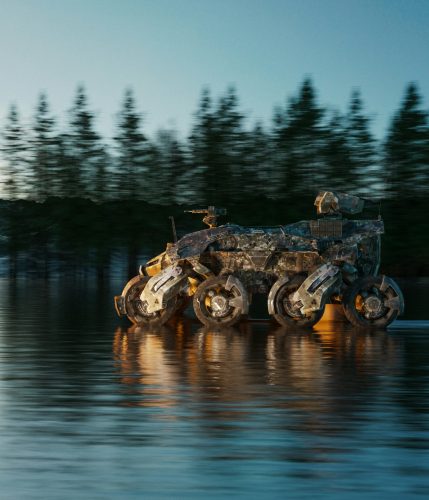
How optionally manned and robotic platforms are reshaping land warfare and why secure, UK-integrated tactical communication is vital to their success.
As armed forces across the globe accelerate the adoption of robotic combat vehicles (RCVs) and optionally manned fighting vehicles (OMFVs), one reality has become undeniable: these platforms are only as effective as the communications infrastructure that underpins them. In modern land warfare, secure and resilient tactical communications are not optional, they are mission critical.
From the U.S. Army’s ambitious OMFV program to European developments like the Milrem Robotics Type X, militaries are investing heavily in uncrewed and hybrid platforms. These systems promise a decisive edge: delivering reconnaissance, direct fire, and logistical support without exposing soldiers to the frontline. Operating in environments that are GPS-denied, electronically contested, or high-threat, they represent the future of battlefield survivability and force projection.
Yet one question remains central: how do you maintain control, coordination, and safety when the crew is not onboard?
The answer lies in communications. Tactical audio infrastructure, from ruggedised intercoms and external loudspeakers to dismount headsets, functions as the command lifeline, bridging human operators, autonomous platforms, and dismounted troops. Whether remotely piloted or operating with autonomous functions, these vehicles rely on secure comms to enable human-machine teaming, ensure mission safety, and guarantee operational control.
This is where Vitavox plays a critical role. Our UK-manufactured, DEF STAN-certified solutions including the VITAVIC 400C Intercom System, Outacom® Tactical PA, and ViTac™ Personal Communication System provide the secure, GVA-ready communications backbone required for autonomy to function in practice.
In this blog, we will explore the platforms, doctrines, and technologies shaping the next era of land warfare and why resilient, interoperable communications remain the indispensable foundation of every autonomous or optionally manned system.
A Robotic Combat Vehicle (RCV) is an unmanned or optionally crewed ground platform designed to perform battlefield tasks without exposing soldiers directly to risk. Unlike logistics-only unmanned ground vehicles (UGVs), RCVs are purpose-built for combat operations, with roles ranging from reconnaissance to direct-fire support.
RCVs differ in size, mission profile, and autonomy level, but all share three fundamental traits:
These features allow RCVs to function as extensions of the force, combining speed, survivability, and expendability in high-risk environments.
Modern RCVs are being trialled and deployed for tasks such as:
While “UGV” is a broad category, covering platforms from mine-clearance bots to resupply carriers, an RCV is combat-focused. It is designed for integration into tactical manoeuvres, not just support functions. For defence planners, this distinction matters: UGVs reduce workload, but RCVs can actively shape the fight.
Without robust communications, even the most advanced RCV is just hardware on tracks. To operate effectively, an RCV must:
Receive commands and transmit data in real time.
In electronic warfare (EW) environments, these demands intensify. Communications must be ruggedised, redundant, and NATO-interoperable to survive jamming, spoofing, and cyber threats.
An Optionally Manned Fighting Vehicle (OMFV) is a new generation of combat platform designed to operate either with a crew onboard or under remote/autonomous control. Unlike traditional armoured vehicles, OMFVs provide commanders with flexibility: deploy crew when human presence is essential, or switch to unmanned mode when the risk is too high.
OMFVs are not simply modified armoured vehicles, they are designed from the ground up with dual-role architecture. Key differentiators include:
This flexibility means OMFVs can adapt across mission profiles from high-intensity mechanised warfare to urban operations, without requiring separate fleets of crewed and uncrewed vehicles.
For NATO, survivability and interoperability are paramount. OMFVs address both:
In practice, this makes OMFVs ideal for modern conflicts, where adversaries contest the electromagnetic spectrum and employ hybrid tactics. Their success, however, does not hinge solely on armour or firepower, but on the ability to stay connected.
That’s why Vitavox communication systems, from the VITAVIC Intercoms to Outacom® Tactical PA are critical enablers, ensuring OMFVs function safely and effectively across all modes of operation.
As land forces shift toward mixed formations of crewed and uncrewed platforms, human-machine teaming has become central to modern doctrine. These operations depend on one critical factor: trust through connectivity. Without secure communications, robotic vehicles cannot function as trusted partners, only as liabilities.
Human-machine teaming is the coordinated employment of soldiers and semi-autonomous systems, combining human decision-making with machine speed and endurance. This may include:
In each case, communication systems form the interface that translates intent into action.
Human-machine teaming cannot succeed without:
This is where Vitavox products deliver strategic value. The ViTac™ PCS provides dual-channel soldier-to-vehicle communication, while the VITAVIC 400C Intercom ensures secure voice/data continuity between onboard crew and remote operators.
Together, these systems allow robotic and manned units to function as a cohesive force, ensuring autonomy enhances, rather than replaces, human command.
Robotic and optionally manned systems are no longer confined to prototypes or test ranges, they are entering live procurement cycles across NATO and beyond. Several key platforms illustrate the range of approaches, from European mid-weight combat UGVs to the U.S. Army’s ambitious OMFV program.
The U.S. Army’s OMFV program is one of the most ambitious ground vehicle initiatives in decades. BAE Systems’ bid focuses on digital modularity, optional manning, and autonomous readiness. Unlike legacy vehicles, OMFVs are built for crew-on or crew-off flexibility, supported by encrypted comms and multi-role payloads. Their operational viability depends heavily on resilient communications, an area where UK-compliant systems like VITAVIC 400 and Outacom® Tactical PA provide clear integration pathways for NATO alignment.
NATO members are actively trialling robotic combat platforms for operational validation. These exercises such as Exercise CABRIT, highlight the strategic importance of interoperability and communications assurance. For the UK MOD, this underscores a procurement priority: any autonomous or optionally manned platform must integrate seamlessly with legacy Bowman, future Morpheus, and NATO-standard networks. Vitavox hardware, already DEF STAN-certified, delivers this assurance.
Across these programmes, one theme is constant: communications dictate operational relevance. Without secure, NATO-compliant links, even the most advanced robotic vehicle becomes a battlefield liability. By embedding trusted, UK-manufactured comms like Vitavox’s ViTac™ PCS and Outacom® Tactical PA, integrators ensure platforms are not only survivable but also fully interoperable within coalition operations.
In modern land warfare, the primary threat to autonomous and optionally manned vehicles is not terrain, it’s the electromagnetic spectrum. From GPS spoofing to broadband jamming, adversaries are developing increasingly sophisticated ways to disrupt robotic combat vehicles (RCVs) and optionally manned fighting vehicles (OMFVs). For NATO and UK MOD, deploying these systems without assured communications is operationally unacceptable.
Autonomous vehicles must operate in environments where GPS signals are unreliable, or deliberately denied. Adversaries exploit this weakness with electronic warfare (EW) tools, attempting to sever command links and degrade situational awareness. Vitavox addresses these challenges through:
This hardware-first resilience ensures that even when digital networks are targeted, soldiers retain the ability to command, coordinate, and override their platforms.
The UK MOD mandates compliance with DEF STAN 23-09, the standard that governs Generic Vehicle Architecture (GVA) integration. This ensures that communication systems can be installed across multiple platforms without costly redesigns. Vitavox products, including the VITAVIC 400C Intercom, ViTac™ PCS, and Outacom® Tactical PA, are all engineered to meet these standards. For integrators, this reduces project risk, accelerates acceptance, and guarantees future-proof compatibility.
With sovereign supply chains a growing priority, UK-manufactured solutions offer both operational and political advantages. Vitavox systems are:
For primes and integrators, this delivers not only faster lead times but also compliance with MOD requirements for sovereign capability and through-life support.
Combat platforms are built for decades of service. Communication systems must therefore be:
Vitavox offers full refurbishment and certification services, allowing long-term cost savings and compliance across generations of vehicles.
By choosing DEF STAN-compliant, UK-manufactured comms, integrators ensure their RCV and OMFV programmes remain certified, supported, and NATO-interoperable from day one, reducing procurement risk and maximising operational readiness.
Autonomous systems are no longer experimental, they are already reshaping how NATO and allied forces operate on land. From light robotic scouts to heavily armed optionally manned fighting vehicles (OMFVs), these platforms promise new levels of capability, survivability, and operational reach. Yet their effectiveness hinges on one factor above all: communications resilience.
Without secure, interoperable, and mission-certified comms, robotic combat vehicles become liabilities rather than force multipliers. Navigation logic, AI software, and modular payloads may enable autonomy, but it is the tactical communications backbone that ensures human oversight, system control, and safe integration within mixed NATO formations.
That is where Vitavox delivers unique, sovereign value. Our UK-manufactured systems including the VITAVIC 400C Intercom, Outacom® Tactical PA, and ViTac™ PCS, are DEF STAN-compliant, NATO-ready, and engineered to perform in contested environments where lesser systems fail.
By focusing not on autonomy software, but on the command lifelines that connect soldiers, vehicles, and command networks, Vitavox enables the safe and effective deployment of robotic and hybrid land platforms.
Contact Vitavox today to explore how our tactical communications systems can support your integration of robotic combat vehicles and OMFVs, ensuring they remain connected, compliant, and combat-ready.
